
Your Holiday Strategy Can’t Wait for Black Friday
Explore the five decisions
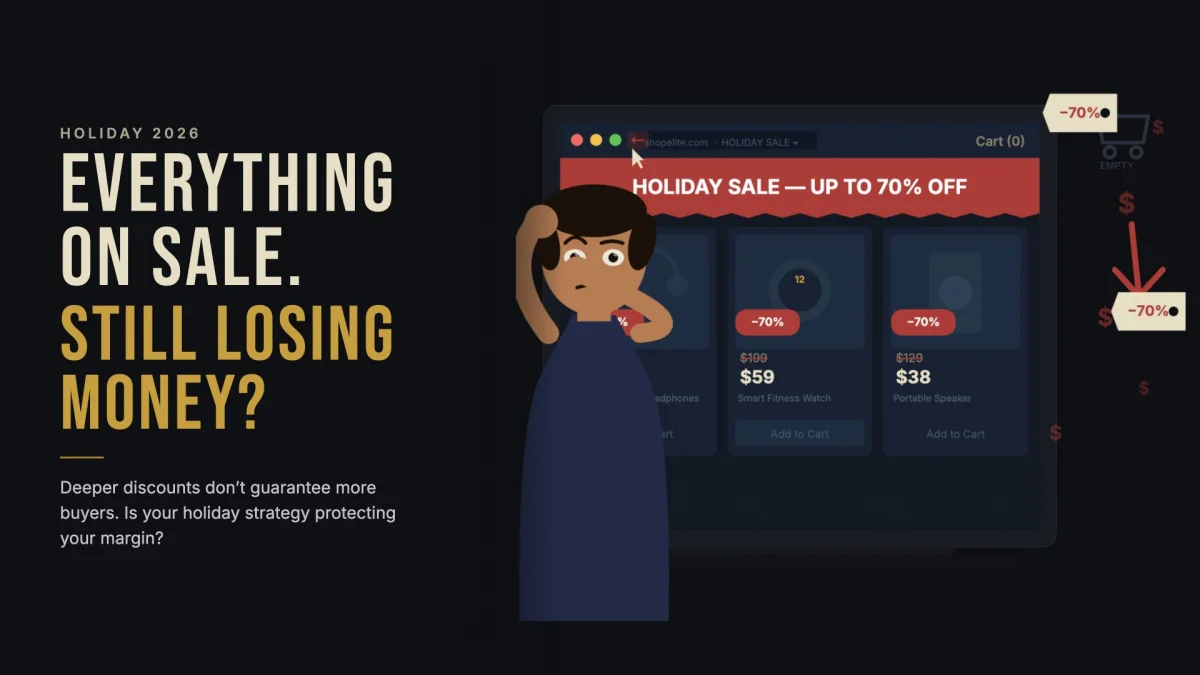
A packed order queue can make a business look healthy while the cash account tells a different story.
Cash is tied up in inventory. Discounts take a bite out of the margin. Shipping can cost more than the spreadsheet allowed for. Returns may arrive after the celebration.
Meanwhile, someone is asking whether we should spend more on ads.
Maybe we should. But first, we need to know what those additional orders will do for the business.
Holiday 2026 planning needs that conversation now, while there’s still time to change the offer, the inventory plan and the customer experience. Waiting until a campaign underperforms means making expensive decisions under pressure.
For e-commerce shops and retailers selling both online and in-store, the challenge reaches beyond the promotion calendar. Your customer’s budget has to cover more than your promotion. You’re competing with other retailers, other categories and the decision to wait. Give them a clear reason to choose you.
A national spending forecast won’t tell you whether your particular customer still wants your particular product at your particular price. Your own demand signals, economics and operational limits are where the useful answers start.
Here are five questions we’d put on the table before approving the holiday plan.
1. What are customers actually trying to buy?
Choose offers around what customers need, then prove the interest.
Start with the products people are searching for, asking about, buying and coming back to purchase. Compare recent performance with a comparable period, accounting for stock availability, promotions and changes in acquisition spend. Separate a seasonal dip from a category losing momentum.
There will be plenty of temptation to run the familiar holiday playbook: mark down lingering 2026 inventory, blow out older 2025 products, free up shelf space and recover cash tied up in stock.
Sometimes that’s the right call. But will those sales generate enough revenue and leave enough margin to carry the business through this holiday season?
In the specialty-retail data we’re reviewing, the demand signals suggest clearance alone won’t be enough. In that data, we’re seeing customers take more time, compare more carefully and question whether a discount or bundle is worth buying when the product wasn’t on their list to begin with. When a “sale” price is still higher than the regular price they remember from a year ago, the markdown has more work to do to earn their trust.
Moving old inventory can solve a stock problem. It still needs to fit what customers want, what they can afford and what the business needs to earn.
Give clearance its own audience and a deliberate place in the promotion. Don’t let aging stock crowd out the products customers came to find. And consider what repeated markdowns teach your returning customers: if waiting repeatedly earns a lower price, you may be giving them a reason to delay their next purchase.
If demand has shifted, a new landing page may help. It may also be the wrong fix.
Look at the customer’s next need. Accessories, replacement parts, useful bundles and consumables can create reasons to return without requiring another expensive flagship purchase. That opportunity depends on your catalog and customer base; prove the interest before buying inventory around it.
Our approach draws on hands-on e-commerce work connecting product searches, broader category questions and parts or accessory needs. Each brings a different customer intention. Someone comparing their first purchase needs help choosing; an owner looking for a compatible part needs a direct answer and an easy route to checkout. Connecting the content, product information and purchase path is where marketing and merchandising start working together.
Choose a small number of offers with a clear customer reason to exist. Give each an owner and a way to judge whether it worked.
2. Holiday revenue is not holiday profit.
Judge the offer by what remains after the costs of winning and fulfilling the order.
Which orders are actually worth winning? Start with the selling price after discounts. Subtract the landed product cost, including applicable duties and freight, then payment fees, fulfillment, shipping you absorb, expected returns and the cost of acquiring the order.
What remains is the order’s contribution toward overhead and profit. An impressive revenue number can hide very little left to run the business.
- Landed product cost Including applicable duties and freight
- Payment fees
- Fulfillment
- Shipping we absorb
- Expected returns
- Acquisition cost
Run the promotion through a few scenarios: the expected order mix, a lower basket value, a higher return rate or a shipping cost increase. Decide what would make you change the offer or slow the spend.
A bundle earns its place when it solves a problem: a complete setup, compatible accessories, a gift that’s ready to give or fewer decisions at checkout. Putting two slow sellers in the same box doesn’t establish a reason to buy.
A blanket discount can also give away margin on products customers were already willing to buy. Test the offer against both customer interest and contribution before making it the centerpiece of the season.
3. Can the inventory plan survive the cash plan?
Make payment timing visible alongside the inventory plan.
Profit and available cash are different questions.
Put purchase orders, supplier payment dates, payroll, debt payments and expected receipts on the same cash forecast. Make the timing visible. A profitable product can still leave you short if you have to fund too much stock before the money comes back.
- CommitPurchase ordersReview the stock commitment and supplier terms.
- FundPayment datesPlace supplier payments alongside payroll and debt payments.
- RecoverExpected receiptsCheck when cash is expected to come back.
Illustrative sequence, not a scaled forecast. Actual payment terms and cash timing vary.
Review replenishment by product. Protect reliable sellers with a sensible buffer. Be cautious with uncertain demand. Ask about smaller orders, delivery timing or supplier terms before treating financing as the only answer.
And account for lead times. Buying closer to demand only helps when the supply chain can support it. Running out of your strongest item has a cost too.
Protect the reputation behind the sale.
Before pushing for more orders, ask whether you can deliver what you’re promising. That means available stock, realistic supplier lead times, fulfillment capacity and enough customer support to handle problems when they happen.
Selling beyond what you can reliably supply can turn a strong promotion into missed delivery dates, cancellations and frustrated customers. During the holidays, a late order may also mean a gift that never arrives in time. The customer remembers that experience long after they forget the discount.
Be clear about stock, shipping cutoffs and any backorders before checkout. If capacity is getting tight, adjust the promise, redirect the promotion or slow the spend. Don’t keep taking orders on the hope that the team or supplier will somehow catch up.
We have to be careful not to get greedy. A short-term revenue push can cost you repeat customers, bring negative reviews and damage trust that takes much longer to rebuild. Grow at a pace your business can support. Your reputation has to survive the season too.
4. Have we made the purchase easy to trust?
Make the product, full cost and delivery promise easy to understand.
A shopper should be able to understand the product, its fit, the full purchase cost and when it can arrive. Check those answers on a phone, where people actually encounter the campaign.
Then complete the journey yourself: ad or email, product page, cart, checkout and confirmation. Look for missing compatibility information, confusing offers, delivery uncertainty and unanswered questions.
- CampaignA clear offer
- ProductFit and compatibility
- CartThe full cost
- CheckoutDelivery clarity
- Confirmation & deliveryA promise we can keep
Complete this journey on a phone. Note the unanswered questions before sending more traffic.
Traffic may be the constraint. Conversion, product fit or fulfillment may be the constraint instead. Find the one that matters before sending more people into the same friction.
Give existing customers a useful reason to return, and make that journey as deliberate as the first purchase. Start with what they already own and what they may need next: replenishment, a compatible accessory, an upgrade or guidance that helps them get more from their purchase.
That gives your email and remarketing a purpose beyond announcing another sale. Segment where the data supports it, then measure the response. An existing customer relationship is an opportunity, not a guarantee that every campaign will be profitable.
5. Who changes the plan when the evidence changes?
Agree on the signals, the decision owner and when to change course.
A calendar of scheduled campaigns is only part of the job.
Agree on the signals you’ll review, who can make a decision and how quickly the team can act. Watch contribution, conversion, stock availability, customer questions and cash alongside revenue.
Set the thresholds in the context of your business. A higher acquisition cost may be acceptable for an offer with stronger contribution or a repeat-purchase record that supports it. Check whether you can afford the time it takes to earn that return. The same cost may be unacceptable for another.
Stay willing to change a weak offer, redirect spending or revise a purchasing decision. Attachment to the original plan gets expensive when the customer has already moved on.
Put the plan to work this week.
Before the next planning meeting, bring five things:
You don’t need a finished holiday calendar to start. You need enough evidence to make the next decision, and enough time to change course.
At RevenueTHESIS, this is how we approach growth: understand the constraint, choose the work that will matter and connect marketing decisions to the business that has to deliver them.
If you’d like a fresh set of eyes on your data, offers or holiday direction, reach out. We can help you identify what needs attention and turn that into a practical plan for your team.
If you haven’t started, you’re late. But you’re not too late. Whether we work together or not, start this week. You still have runway. Use it.
What decision in your holiday plan still needs better evidence: the offer, the inventory commitment or the acquisition budget?